
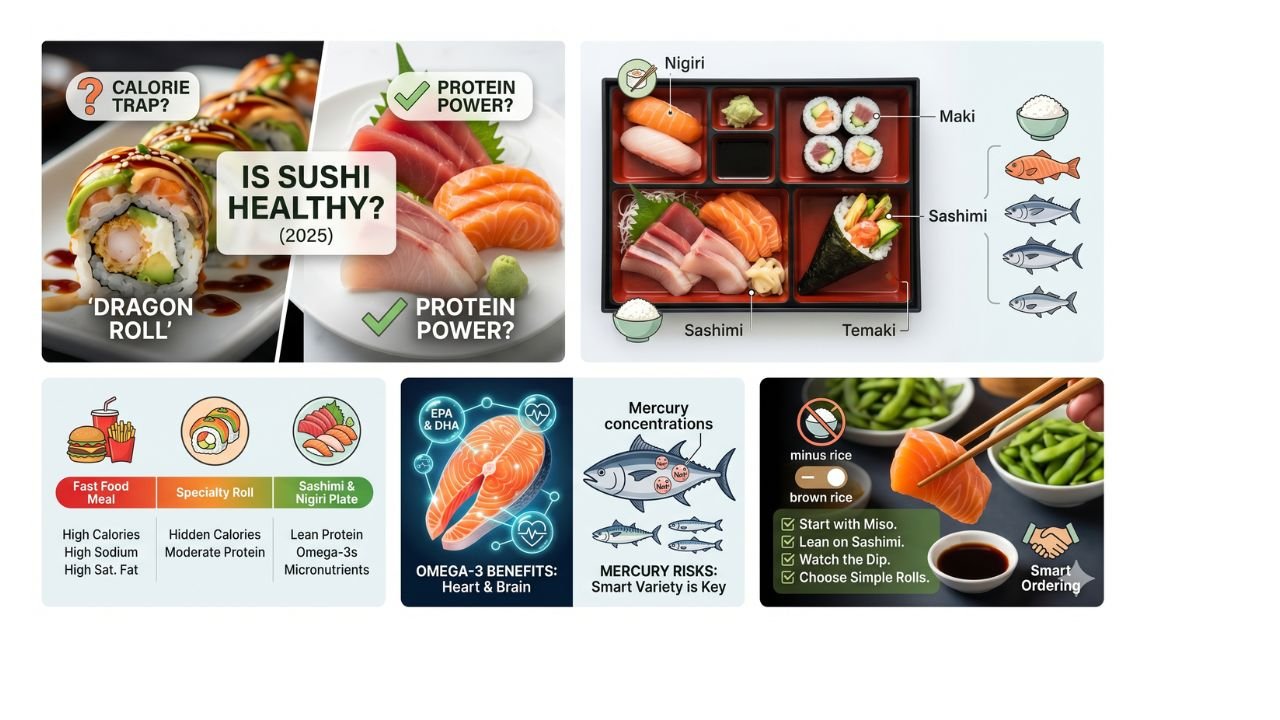
You sat down at your favorite sushi restaurant, scanned the menu, and then that familiar question crept in — is sushi actually healthy, or am I fooling myself?
You are not alone. Millions of people ask the same thing every day. And the honest answer is: it completely depends on what you order. Sushi can be one of the most nutritious meals on the planet — or it can quietly pack in more calories and sodium than a fast food burger. The gap between the two is not in the cuisine itself, but in the choices you make at the table.
In this guide, we cut through the noise. No fluff, no generic lists. Just the real nutritional science behind sushi, the smartest choices you can make, the hidden traps to avoid, and everything that affects your health — from omega-3 content to mercury risks.
| Quick Answer: Yes, sushi is healthy — when you choose wisely. Sashimi, nigiri, and simple vegetable rolls deliver lean protein, omega-3 fatty acids, and essential micronutrients with relatively few calories. Deep-fried rolls loaded with cream cheese and spicy mayo? Not so much. |
What Exactly Is Sushi? (Beyond the Basics)
Most people think of sushi as “raw fish wrapped in rice.” That is a starting point, but the definition is broader than that. Sushi, at its core, is vinegared rice — the word itself comes from an old Japanese term meaning “sour-tasting.” The fish, vegetables, and toppings are the accompaniments, not the defining element.
Sushi traces its roots back to 7th-century Southeast Asia, where fish was preserved by fermenting it with rice and salt. Over centuries, the dish evolved dramatically. By the early 19th century in Tokyo (then called Edo), the modern version we recognize today — fresh fish pressed over seasoned rice — was born as a fast street food.
Today, the sushi world breaks down into several main categories:
- Nigiri — a hand-pressed mound of rice topped with a slice of fish, egg, or another ingredient. Simple, elegant, and usually the leanest option.
- Maki — rice and fillings rolled inside nori (seaweed), then sliced into rounds. Comes in hosomaki (thin rolls), futomaki (thick rolls), and uramaki (inside-out rolls where rice faces outward).
- Sashimi — sliced raw fish served without rice. Technically not sushi at all, but always found on sushi menus. Calorie-for-calorie, the most protein-dense and lowest-carb option.
- Temaki — a hand-rolled cone of nori filled with rice, fish, and vegetables. Casual and customizable.
- Chirashi — scattered sushi, where various fish are served over a bowl of seasoned rice. A full, balanced meal in one bowl.
Sushi Nutrition Facts: What You Are Actually Eating
Here is where most sushi articles gloss over the details. Let us be specific. The calorie and nutrient content of sushi varies wildly depending on the roll, and understanding this is the foundation of eating sushi smartly.
| Sushi Type (6-8 pcs) | Calories | Protein | Carbs | Key Notes |
| Sashimi (6 slices) | ~150-200 | ~25g | 0g | Lowest calorie, highest protein |
| Salmon Nigiri (2 pcs) | ~130-140 | ~10g | ~18g | Rich in omega-3s |
| Cucumber Roll | ~100-135 | ~4g | ~24g | Ultra-light, high fiber |
| California Roll (8 pcs) | ~250-340 | ~9g | ~38g | Moderate — watch imitation crab |
| Spicy Tuna Roll | ~290-350 | ~13g | ~26g | Spicy mayo adds fat & calories |
| Avocado Roll | ~180-220 | ~4g | ~28g | Healthy fats from avocado |
| Dragon Roll | ~430-500+ | ~15g | ~50g | High calorie specialty roll |
| Shrimp Tempura Roll | ~500-600+ | ~16g | ~64g | Deep-fried — limit frequency |
| Philadelphia Roll | ~400-450 | ~14g | ~38g | Cream cheese = high sat. fat |
Notice the spread: sashimi clocks in around 150-200 calories for six slices and delivers 25 grams of protein. A shrimp tempura roll? You might be looking at 500-600 calories — and that is before you factor in soy sauce, edamame, and miso soup on the side.
The Real Health Benefits of Sushi (Backed by Science)
When you choose the right sushi, you are genuinely doing your body a favor. Here is what the research actually shows:
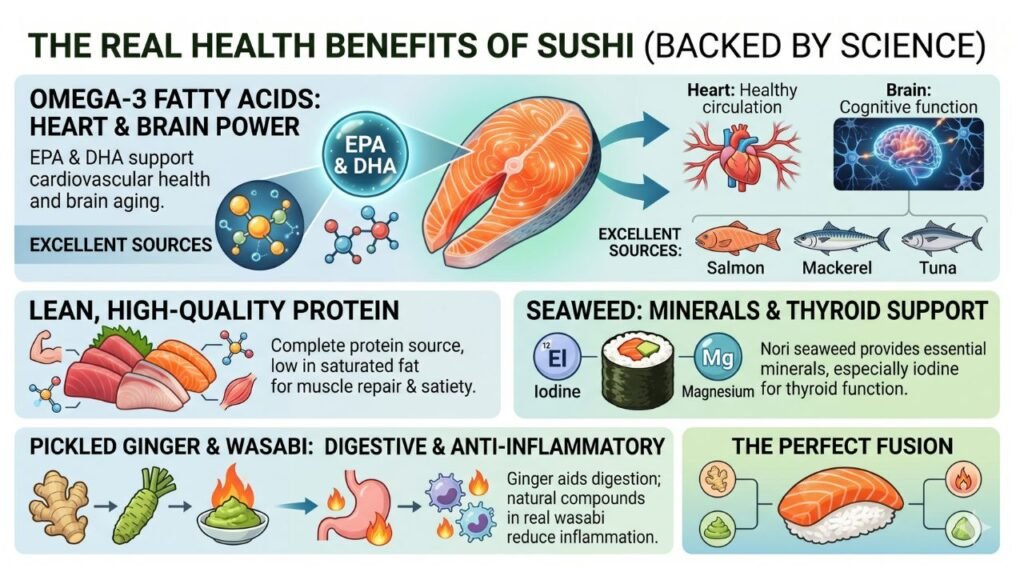
1. Omega-3 Fatty Acids: The Heart and Brain Connection
Fatty fish like salmon, tuna, and mackerel — staples of good sushi — are among the richest food sources of EPA and DHA omega-3 fatty acids on Earth. These are not interchangeable with plant-based omega-3s (ALA). Your body converts ALA inefficiently, but EPA and DHA from fish are absorbed directly and put to work immediately.
A 2021 study published in JAMA Internal Medicine found that regular fish consumption was associated with meaningfully lower risk of heart attack and stroke in people with existing cardiovascular disease. A 2022 review in Cureus found omega-3s support memory and cognitive function — meaning your salmon nigiri is doing something real for your brain.
The American Heart Association recommends eating fish at least twice a week. Two sushi dinners a week? You are already there.
2. High-Quality Lean Protein
Sushi fish is lean, complete protein — meaning it contains all essential amino acids your body cannot make on its own. Unlike red meat, it delivers this protein with minimal saturated fat. Sashimi especially is essentially protein delivered in the most efficient, clean form possible.
Protein matters beyond just muscle building. It keeps you fuller for longer, supports immune function, helps maintain skin and hair health, and regulates countless metabolic processes. A sashimi dinner is, nutritionally speaking, an excellent high-protein meal by any standard.
3. Nori (Seaweed): The Underrated Superfood
The dark green sheet wrapped around your maki roll is doing a lot of quiet work. Nori contains calcium, magnesium, phosphorus, iron, iodine, vitamins A, C, E, and B1. A 2023 study in Food Science and Nutrition found that a sushi meal including nori and wakame seaweed delivered meaningful amounts of bioavailable iodine — about 75% was absorbed within 24 hours.
Iodine is critical for thyroid function, which regulates your metabolism, energy levels, and hormonal balance. Many people are mildly deficient without knowing it. Your sushi roll is quietly supporting your thyroid.
Some research also suggests seaweed’s ability to bind and help remove heavy metals from the body — a useful counterpoint given the mercury concerns people raise about sushi fish.
4. Wasabi: More Than Just Heat
Real wasabi — made from grated Eutrema japonicum — contains glucosinolates and isothiocyanates, compounds with demonstrated antibacterial, anti-inflammatory, and potential anticancer properties. The catch: most restaurants outside Japan serve a mix of horseradish, mustard powder, and food coloring that mimics wasabi’s appearance and heat but lacks its bioactive compounds. If you can find real wasabi, it is worth it.
5. Pickled Ginger (Gari): The Digestive Reset
That pale pink ginger served alongside your sushi is not just a palette cleanser. Ginger has a well-established body of research behind it showing anti-inflammatory and antinausea properties. It also supports healthy digestion and may offer some protection against respiratory viruses. Eat it between rolls — it is doing more than you think.
6. Anti-Inflammatory Profile
Chronic inflammation sits at the root of most modern diseases: heart disease, type 2 diabetes, certain cancers, and neurodegeneration. The omega-3 fatty acids in sushi fish directly counteract inflammatory pathways. So does the wasabi, the ginger, and even the nori. A well-chosen sushi meal is, in aggregate, a genuinely anti-inflammatory meal.
The Hidden Risks — What You Need to Watch
Sushi is not without its legitimate concerns. Here is an honest look at the downsides, and what you can actually do about them:
Mercury: The Real Risk, Put in Context
Mercury accumulates in fish through a process called biomagnification — larger, longer-lived predatory fish accumulate more than smaller fish. The FDA identifies bigeye tuna, swordfish, shark, king mackerel, and orange roughy as high-mercury fish that pregnant women, breastfeeding mothers, and young children should avoid.
For healthy adults, the picture is more nuanced. The FDA recommends two to three servings per week of lower-mercury fish — salmon, light tuna, shrimp, crab, and clams all qualify. The solution is not to avoid sushi, but to vary your fish choices rather than eating tuna-heavy rolls every single day.
Sodium: The Quiet Accumulator
This is the sneakier problem. A single tablespoon of regular soy sauce contains roughly 900 mg of sodium — that is nearly 40% of the daily recommended limit in one dip. Add sushi rice (already seasoned), imitation crab (high in sodium), and miso soup on the side, and a sushi dinner can easily hit 2,000-3,000 mg of sodium before you realize it.
High sodium intake raises blood pressure, causes water retention and bloating, and over time contributes to cardiovascular disease and kidney strain. Switching to low-sodium soy sauce cuts the sodium by about 40-50%. Using a light dip rather than drenching the rice helps enormously. And choosing sashimi over rice-heavy rolls significantly reduces baseline sodium.
Refined Carbohydrates: The Blood Sugar Spike
Sushi rice is white, short-grain rice seasoned with sugar and vinegar. It sits high on the glycemic index. Eight pieces of a specialty roll can deliver 50-70 grams of carbohydrates, the equivalent of three or four slices of white bread. For people managing diabetes, insulin resistance, or following a low-carb diet, this matters significantly.
The rice vinegar in sushi rice has some redeeming value — research suggests it may modestly help lower blood sugar and blood pressure. But it does not negate the carbohydrate load of large specialty rolls. Requesting less rice, choosing brown rice where available, or focusing on sashimi are the practical solutions.
Foodborne Illness Risk
Raw fish carries a genuine — if statistically small — risk of bacteria (salmonella, listeria, vibrio) and parasites including tapeworm. Reputable sushi restaurants in the US are legally required to freeze raw fish to FDA-specified temperatures first, which kills most parasites. The risk is highest at lower-quality establishments.
Pregnant women, young children, the elderly, and immunocompromised individuals should stick to cooked sushi options: shrimp, eel (unagi), egg (tamago), crab (kani), or vegetable rolls.
The Calorie Trap of Specialty Rolls
This is where people get genuinely surprised. A single rainbow roll or dragon roll at a typical sushi restaurant can contain 500-600 calories. Pair it with a spicy tuna roll and a California roll and you have consumed 1,200-1,400 calories — comparable to a large fast food meal — while believing you ate lightly. Tempura batter, cream cheese, spicy mayo, eel sauce, and imitation crab all add up fast.
Best Sushi Choices: Ranked From Healthiest to Most Indulgent
Here is a clear hierarchy to guide your ordering:
| Tier | Sushi Type | Why It Works | Watch Out For |
| Best | Sashimi (any fish) | Zero rice, max protein, lowest calories | Mercury in high-frequency tuna |
| Best | Salmon Nigiri | Omega-3 powerhouse, minimal rice | Sodium from soy sauce |
| Best | Tuna Nigiri | Lean protein, low fat, B vitamins | Limit to 2-3x per week (mercury) |
| Good | Cucumber Roll (Kappa Maki) | Very low calorie, high fiber | Minimal protein — pair with sashimi |
| Good | Avocado Roll | Healthy monounsaturated fats | Moderate calories from avocado |
| Good | Salmon Avocado Roll | Best of both: omega-3s + healthy fat | Rice adds carbs — keep to 1-2 rolls |
| Good | Rainbow Roll | Nutrient variety, lean proteins | Calorie count rises — share it |
| Moderate | California Roll | Familiar, moderate calories | Imitation crab = high sodium & additives |
| Moderate | Spicy Tuna Roll | Good protein, just watch the sauce | Spicy mayo = significant fat & calories |
| Limit | Philadelphia Roll | Salmon is healthy, cream cheese is not | Saturated fat, cholesterol-heavy |
| Limit | Shrimp Tempura Roll | Tasty but deep-fried = calorie bomb | 400-600+ calories, trans fats from frying |
| Limit | Dragon Roll / Volcano Roll | Heavy sauces, complex toppings | Often 500+ cal, high sodium & sugar |
Is Sushi Healthy For You Specifically? Different Needs, Different Answers
If You Are Trying to Lose Weight
Sushi can absolutely support weight loss — with the right approach. Focus heavily on sashimi and nigiri. Skip specialty rolls with heavy sauces. One practical trick: eat a piece of sashimi between rolls to keep protein intake high and hunger in check. Miso soup before your meal is low in calories and surprisingly filling — it helps you eat less overall.
A basic tuna or salmon roll contains 180-250 calories. Build your meal around two to three of those plus a sashimi plate and miso soup, and you have a satisfying, nutrient-dense meal well under 600 calories.
If You Are Pregnant
Sushi is not completely off-limits during pregnancy, but raw fish is. Choose fully cooked options: shrimp sushi, eel (unagi, which is always cooked), tamago (egg), California rolls (imitation crab is cooked), and vegetable rolls. Avoid high-mercury fish entirely. Salmon is generally fine when cooked — it is lower in mercury and high in the DHA omega-3 that is critical for fetal brain development.
If You Have Diabetes or Monitor Blood Sugar
The refined carbohydrates in sushi rice are your main challenge. Request brown rice where available. Build your meal primarily around sashimi. Limit rolls to one or two and fill the rest with sashimi, edamame, and miso soup. Avoid rolls with sweetened sauces (eel sauce, sweet chili, and teriyaki drizzles all contain sugar). Low-sodium soy sauce, used sparingly, is fine.
If You Have High Blood Pressure
Sodium is your biggest watch point. Ask for low-sodium soy sauce or bring your own. Avoid imitation crab (high in sodium), miso soup can be skipped if you are very sensitive, and limit the number of rolls containing heavy sauces. The omega-3 fatty acids in sushi fish actually support heart health and may mildly lower blood pressure — so the fish itself is your friend here.
If You Are Vegetarian or Vegan
You have excellent options. Cucumber rolls, avocado rolls, sweet potato rolls, pickled plum (umeboshi) rolls, edamame, and seaweed salad all deliver fiber, micronutrients, and antioxidants. You will miss out on the omega-3 and protein density of fish-based sushi, so pairing a sushi meal with other protein sources during the day makes sense.
10 Practical Tips to Make Sushi Healthier Every Time
- Start with miso soup. It is warm, low-calorie (about 40-60 kcal), and reduces overall appetite — meaning you are less likely to over-order.
- Order sashimi alongside rolls, not instead of them. Sashimi adds protein without carbs and helps you feel satisfied with fewer rice-heavy rolls.
- Ask for less rice. Most sushi restaurants will accommodate this request. Less rice means fewer refined carbs and a better protein-to-carbohydrate ratio.
- Choose brown rice when available. It has more fiber, a lower glycemic index, and more magnesium and B vitamins than white sushi rice.
- Use chopsticks. This sounds simple, but eating with chopsticks naturally slows you down, giving your brain time to register fullness before you over-order.
- Dip lightly, do not drench. Flip your nigiri and dip the fish side into soy sauce, not the rice. The fish absorbs less sodium, and the rice does not fall apart.
- Use low-sodium soy sauce. It has roughly 40-50% less sodium than regular soy sauce and tastes nearly identical in practical use.
- Pair with edamame as a starter. Edamame is high in protein, fiber, and isoflavones. It costs very little calorically and fills you up before the rolls arrive.
- Rotate your fish choices. Vary between salmon, tuna, shrimp, mackerel, and whitefish. This maximizes nutrient variety and minimizes any single contaminant’s accumulation.
- Eat fresh. Sushi with raw fish is best eaten immediately. If you have leftovers, refrigerate immediately and consume within 24 hours. When in doubt, do not eat it.
How Sushi Compares to Other Popular Meals
Context helps. Is sushi healthy compared to what you might otherwise eat?
| Meal | Approx. Cal | Protein | Sodium | Omega-3? |
| Sashimi dinner (12 slices) | ~250 | ~40g | Low* | Yes |
| 2 Salmon Nigiri + Cucumber Roll | ~330 | ~20g | Moderate* | Yes |
| Cheeseburger & fries | ~850 | ~35g | Very High | No |
| Caesar salad (restaurant) | ~470 | ~12g | High | No |
| Grilled chicken salad | ~380 | ~38g | Moderate | No |
| Dragon Roll + Tempura Roll | ~1100+ | ~30g | Very High | Partial |
| Veggie sushi bowl (chirashi) | ~420 | ~22g | Moderate* | Yes |
*With mindful soy sauce use. Sashimi or nigiri dinners with moderate soy sauce are among the most nutrient-dense, calorie-efficient meals you can order at a restaurant.
Read also:-
- Truffle Poppers Chome SF: Honest Review, Taste, Price, and Experience
- Chome San Francisco Takoyaki Review: Is It Worth Trying?
Frequently Asked Questions About Sushi and Health
Is sushi good for weight loss?
Yes, when ordered thoughtfully. Sashimi and nigiri are high-protein and low-calorie. The challenge comes from specialty rolls with cream cheese, tempura batter, and spicy mayo. Build your meal around sashimi and simple rolls and sushi becomes an excellent weight-loss-friendly option.
Is sushi healthy for diabetics?
It can be, with adjustments. The main concern is white sushi rice, which spikes blood sugar quickly. Choosing brown rice, eating sashimi instead of rolls, and avoiding sweetened sauces makes sushi workable for most diabetics. Always consult your doctor or dietitian for personalized guidance.
Is raw fish safe to eat?
For healthy adults eating at reputable restaurants, yes. Quality sushi restaurants are required by FDA guidelines to freeze raw fish to temperatures that eliminate parasites. The risk remains statistically small for most people, but pregnant women, children, the elderly, and immunocompromised individuals should stick to fully cooked sushi options.
How often can you eat sushi?
Most nutrition experts and the FDA suggest two to three servings of fish per week for healthy adults. Eating sushi two or three times a week — with variety in your fish choices — aligns well with this recommendation. If you eat tuna-heavy rolls daily, mercury accumulation becomes a more serious concern.
Is a California roll healthy?
It is a moderate choice — not the healthiest sushi option, but far from the worst. The avocado and cucumber provide fiber and healthy fats. The main drawback is imitation crab (surimi), which is low in protein and higher in sodium and additives than real crab. It is a fine occasional choice, especially compared to tempura rolls.
Is sushi rice bad for you?
Sushi rice is white rice seasoned with sugar and vinegar. It sits relatively high on the glycemic index. For most healthy people eating reasonable portions, it is not a problem. For those managing blood sugar, choosing brown rice and focusing more on sashimi is the smarter approach.
What is the healthiest fish for sushi?
Salmon tops the list for omega-3 content combined with moderate mercury levels. Mackerel (saba) is extremely rich in omega-3s but has a stronger flavor. Light tuna and shrimp are lean and lower in mercury. Whitefish options like halibut or flounder are very lean. Eel (unagi) is always cooked, flavorful, and a solid source of vitamin A and D.
The Bottom Line: Is Sushi Healthy?
Yes — and the science backs it up. Sushi built around fresh fish, seaweed, and vegetables delivers high-quality protein, heart-healthy omega-3 fatty acids, iodine, vitamins, and minerals that most Western diets are genuinely short on. It is low in saturated fat, moderate in calories (when you choose wisely), and among the most nutrient-dense cuisines available at a typical restaurant.
The version of sushi that is not particularly healthy — cream cheese-stuffed, deep-fried, sauce-drenched specialty rolls drowned in spicy mayo — is far from the original Japanese concept. That version is largely a modern Western invention designed to appeal to richer, more indulgent tastes.
Choose sashimi. Choose nigiri. Choose simple rolls with fresh fish and vegetables. Use soy sauce sparingly. Eat with attention. Done that way, sushi is not just healthy — it is one of the best meals you can regularly eat.
| Pro Tip: When in doubt at a sushi restaurant, lead with a sashimi platter. Add one or two of your favorite rolls. Finish with miso soup if you want something warm. That combination gives you the best nutritional return and keeps your total calorie count in a smart range |

2 thoughts on “Is sushi healthy: The Complete, Honest Guide to Sushi Nutrition (2026)”